 how-to
Fastest Way to Open a Locked Car Without Damage
Last Updated: November 9, 2026
Quick Summary
The fastest way to open locked car doors is to call a licensed car lockout locksmith, who can open the door without damage using professional tools. Verify the business is licensed before anyone touches your vehicle, and ask for the full quote in writing before work begins.
- Call a locksmith immediately if a child, pet, or vulnerable person is inside the car.
- Roadside assistance dispatches a contracted technician, but coverage and per-incident limits vary.
- Getting a replacement key without the original requires your VIN, proof of ownership, and photo ID.
- Older cars with traditional mechanical keys are often easier and cheaper to open and re-key.
- Have at least two working keys for every vehicle and store the spare somewhere secure.
Table of Contents
- The Fastest Way to Open a Locked Car Starts With One Call
- When to Call a Car Lockout Locksmith Instead of Waiting
- How Roadside Assistance for Locked Keys in Car Works
- How Much Does a Car Locksmith Cost and What Affects the Price
- How to Get a Replacement Car Key Without the Original
- Older Cars, Worn Keys and Discontinued Models: What Still Works
- What to Do When a Child or Pet Is Locked in the Car
- Preventing the Next Lockout Before It Happens
- Frequently Asked Questions
The Fastest Way to Open a Locked Car Starts With One Call
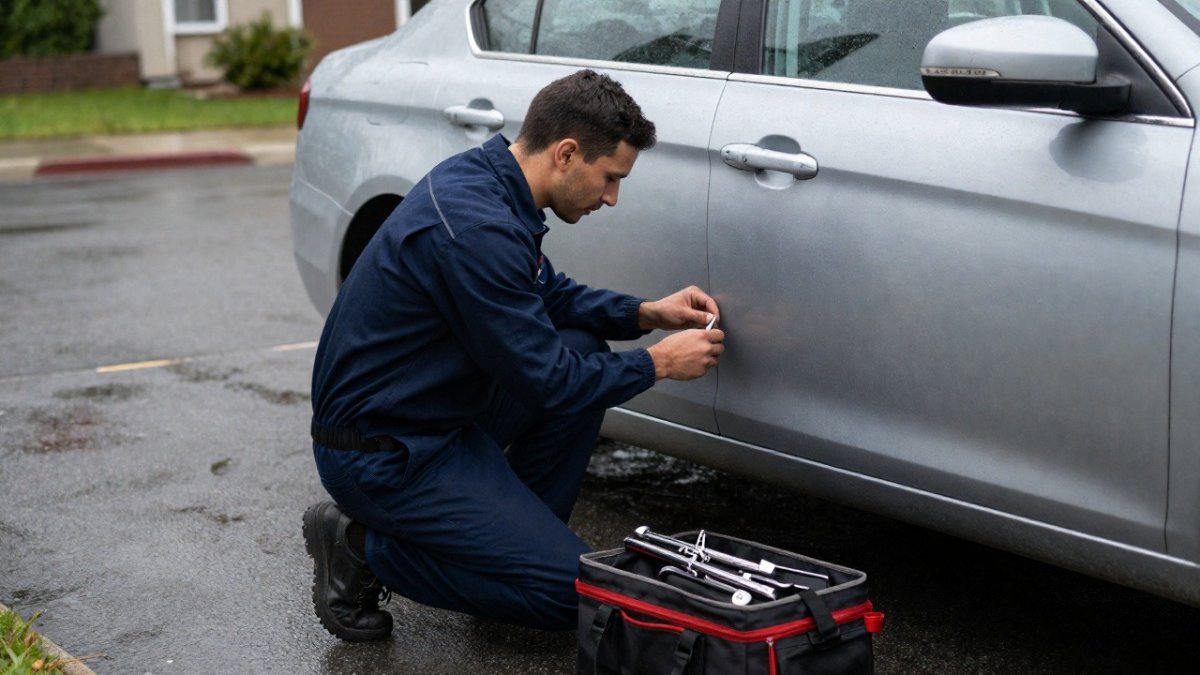
The fastest way to open locked car doors is to call a licensed car lockout locksmith, who can open the door without damage using professional tools.
Why the phone call beats everything else? Because the alternative is a coat hanger, a wedge, or a YouTube tutorial that ends with a scratched door frame or a damaged weather seal. Modern cars also carry side airbags and sensitive wiring inside the door panel. One wrong pry and a cheap lockout becomes an expensive body shop bill.
Below, we'll walk through when to call, what it costs, how to get a replacement key if yours is gone for good, and how to keep it from happening again.
When to Call a Car Lockout Locksmith Instead of Waiting
Call a car lockout locksmith immediately if a child, pet, or vulnerable person is inside the car, if the engine is running, or if the weather is dangerous.
Here's how the common options compare:
- A locksmith: professional tools and a trained technician.
- Roadside assistance: available if you already have coverage.
- A coat hanger or wedge: improvised methods can bend the door frame, tear the rubber seal, or trip the alarm.
- Waiting for a spare key: only practical if someone can reach you quickly.
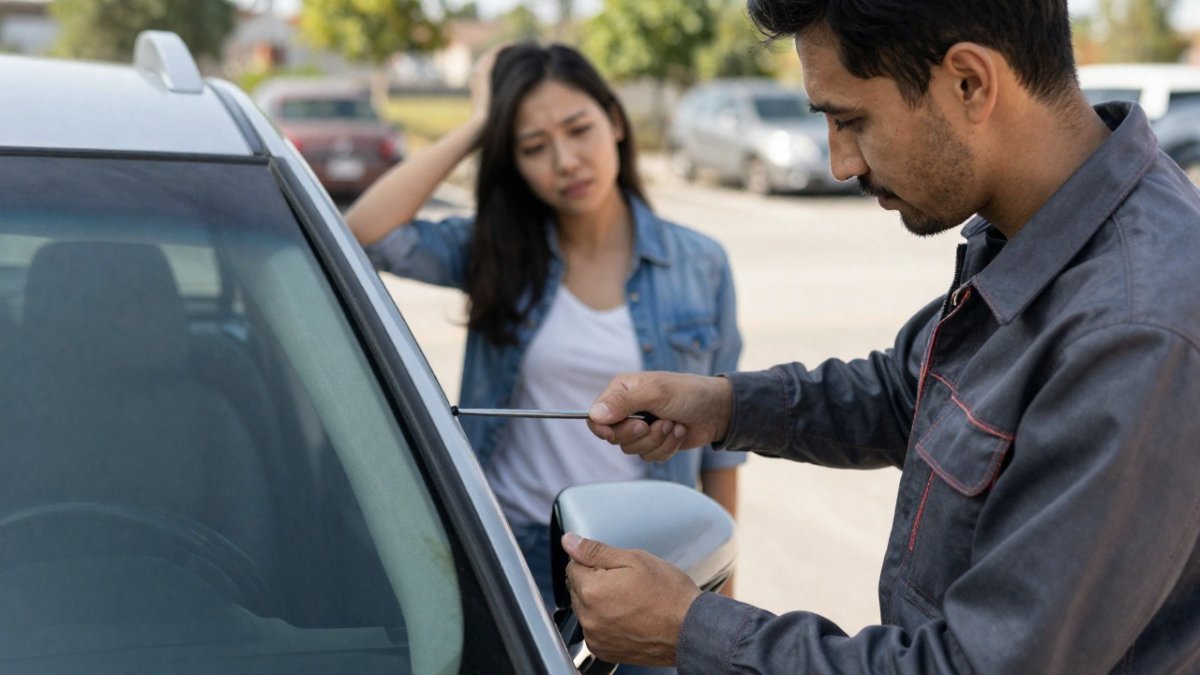
Watch out: verify the business is licensed before anyone touches your vehicle. In California, that means a valid Locksmith Company license, and The Key Shop And More operates under LCO #8717 and #6943. You can see the services we offer on our locksmith services page.
Here is how the common ways to get into a locked car compare.
| Option | What it involves | Key difference |
|---|---|---|
| A locksmith | Professional tools and a trained technician | Fastest, damage-free option |
| Roadside assistance | Provider dispatches a contracted technician | Only practical if you already have coverage |
| A coat hanger or wedge | Improvised methods | Can bend the frame, tear the seal, trip the alarm |
| Waiting for a spare key | Someone brings your spare | Only practical if someone can reach you quickly |
How Roadside Assistance for Locked Keys in Car Works
Roadside assistance for locked keys in car situations works through a dispatch model: you call your provider, they locate a contracted technician, and that technician is sent to your location. It's convenient if you already have coverage through an auto club, insurer, or vehicle manufacturer.
The catch is who actually shows up, since technicians dispatched through roadside programs may vary in equipment and experience.
Before you rely on a roadside plan, ask two questions: does it cover lockouts specifically, and is there a per-incident limit? A plan that covers towing does not always cover a lockout call, and the ones that do may cap the payout. If you're paying out of pocket anyway, calling a local locksmith directly usually cuts out the middleman and the wait.
How Much Does a Car Locksmith Cost and What Affects the Price
Car locksmith pricing depends on the vehicle, the key type, the time of day, and whether a new key has to be cut and programmed. We quote upfront before any work begins.
What Changes the Final Bill
- Vehicle make and model. A basic mechanical door lock is quick work. A late-model car with a shielded door and an immobilizer system takes more time and equipment.
- Key type. A traditional metal key costs far less than a transponder key or a key fob with a remote transmitter.
- Programming. Modern keys must be paired to the vehicle's computer. That requires diagnostic equipment and, often, ongoing software updates.
- Time of day. Pricing may vary for after-hours and holiday calls.
- Location. An open locked car job in a garage is easier to reach than one on a highway shoulder.
If you're price-conscious, browse the shop to see key and locksmith products before you call, and ask for the full quote in writing. Ask for the full quote in writing rather than relying on an advertised starting price.
How to Get a Replacement Car Key Without the Original
Getting a replacement car key without the original is possible in most cases, but the process depends on the vehicle's age and the type of key it uses. A licensed automotive locksmith may be able to cut and program a new key using the vehicle's details and proof of ownership.
Here's what you'll typically need:
- Your vehicle identification number, usually visible through the windshield on the driver's side
- Proof of ownership, such as your registration or title
- A valid photo ID matching the registered owner
From there, the locksmith confirms the key code or reads the lock, cuts a new key blank, and programs it to the immobilizer if required.
Finding a Key Code When the Original Key Is Missing
The key code is a short sequence stamped on the original key tag, printed on the owner's manual card, or stored by the manufacturer. If all of those are gone, a locksmith can decode the lock cylinder directly and cut a new key from the measurements. That's the step most guides skip, and it's the one that saves older cars from a full lock replacement.
Watch out: a locksmith who asks for the VIN and proof of ownership before quoting is following the correct process. Anyone willing to cut a key from a VIN alone, with no ownership check, is a risk to you and to the next owner of that vehicle.
For drivers who want to see what's available, our vehicle key fobs page shows the fobs and key options we stock.
Older Cars, Worn Keys and Discontinued Models: What Still Works
Older cars are often easier and cheaper to open and re-key than new ones, because many use a traditional mechanical key with no immobilizer chip. A worn key can usually be duplicated, though a badly worn original may need to be decoded from the lock itself rather than copied.
A Step-by-Step Decision Tree for Older Vehicles
Use this order to choose the fastest and cheapest option for an older car:
- Do you still have a working key? If yes, a hardware store or automotive locksmith can usually cut a duplicate. For a plain mechanical key, a hardware store is often the fastest stop. For anything with a chip or remote, go to an automotive locksmith or dealer.
- Is the key worn, bent, or rounded? Ask the shop to cut to the manufacturer's specification rather than copy the worn key. If the original is too worn to read, the locksmith decodes the lock cylinder and cuts from those measurements.
- Is the vehicle a classic or pre-immobilizer model? A mechanical-key car can often be opened and re-keyed on site. Confirm the shop stocks or can source the correct blank before you commit.
- Is the model discontinued or the blank obsolete? Call ahead with the year, make, model, and VIN. Ask whether an aftermarket blank or interchangeable keyway is available, and whether the shop can verify fit before ordering.
- Are all keys lost? Expect a decode-and-cut process plus proof of ownership. A dealer may need the car towed in; a mobile automotive locksmith can often do it in the parking lot.
Verifying a Blank Before You Order
Compatibility is where older-car key jobs go wrong. Before ordering an aftermarket or discontinued blank, confirm the keyway profile, the blank length, and whether the vehicle uses a chip. A shop that checks the VIN against its catalog, or test-fits a blank in the lock before cutting, avoids the common outcome of a key that fits the ignition but not the door, or vice versa.
Finding a Key Code When the Original Is Gone
The key code is a short sequence stamped on the original key tag, printed on the owner's manual card, or stored by the manufacturer. If all of those are gone, a locksmith can decode the lock cylinder directly and cut a new key from the measurements. That's the step most guides skip, and it's the one that saves older cars from a full lock replacement.
What to Do When a Child or Pet Is Locked in the Car
Call 911 first if a child or pet is locked in a car, especially in heat or cold.
Never leave a child or pet in a parked car while you run an errand, even briefly (Do you know the the dangers of leaving people or pets in cars during hot weather?). Temperatures inside a closed vehicle climb fast, and a quick stop turns dangerous quicker than most people expect. Keep keys on your person, not in the console, and teach older children how to unlock the door from inside.
Preventing the Next Lockout Before It Happens
Most lockouts are preventable with a few habits and one spare key. Having at least two working keys for every vehicle is a helpful precaution, since a spare made while you still have a working key is typically cheaper and easier than an all-keys-lost replacement.
A short checklist we give every customer:
- Get a spare key cut and programmed before you need it
- Store the spare somewhere secure, not in the glovebox
- Replace worn or damaged keys before they fail in the ignition
- Keep a locksmith's number saved in your phone
- Check that your key fob battery is fresh
If your fob is acting up or your only key is getting worn, deal with it now. A few minutes at the shop beats an hour in a parking lot.
A locked car is stressful. The Key Shop And More is a family-owned, locally operated business serving the Sacramento area. We handle automotive key cutting and programming, residential and commercial locksmith work, and we operate under LCO #8717 and #6943.
Frequently Asked Questions
What is the fastest safe way to get into a locked car?
Call a licensed car lockout locksmith first. A trained technician with the right tools can open a vehicle without damage. Roadside assistance can work if you already have a membership, but dispatch times vary. Avoid the coat hanger trick and pry bars, which can bend window frames, tear weather stripping or damage door lock cylinders.
Can a locksmith unlock a car without damaging it?
Yes. A car lockout locksmith uses professional tools to open the door from the outside. In California, ask for the Locksmith Company (LCO) license number before you agree to service. The Key Shop And More operates under LCO #8717 and #6943.
How much does a car locksmith cost, and can I get a replacement key without the original?
Pricing depends on the vehicle, the time of day and whether a key needs cutting or programming, so ask for a quote upfront rather than trusting an advertised starting price. If the original key is gone, a locksmith can often decode the lock or pull the key code from the vehicle identification number, then cut and program a new key. For older cars with mechanical keys, this is usually straightforward. Call The Key Shop And More for current pricing.
Does roadside assistance cover car lockouts, and how long does it take?
Many roadside assistance plans include lockout service, but coverage depends on your plan and wait times can run long during busy hours. Calling a local locksmith directly is an option to consider. If you are locked out with the engine running or a child or pet inside, call 911 first, then a locksmith. Keep a spare key stored outside the vehicle to avoid the next lockout.