 ultimate-guide
7 Residential Master Key System Benefits for Homeowners
Last Updated: November 6, 2026
Quick Summary
A master key system lets one set of keys open the right doors for every person in a home, without giving everyone access to everything. It uses a key hierarchy of change keys, submasters and a master key, so each person gets access matched to their needs. It reduces the number of keys to carry and makes lost keys easier to manage.
- Each adult can carry a change key for their own room and a submaster for shared areas.
- Use two or three key levels, since each added level increases cost and the chance of error.
- Keep a written key register listing who holds each level and which doors each key opens.
- A lost master key opens every lock, so rekey the affected levels as soon as one goes missing.
- Rekeying existing locks is generally cheaper than replacing them, if the hardware is in good condition.
Table of Contents
- What a Master Key System Is and How It Works
- Key Benefits for Homeowners and Families
- Residential Master Key System Design: Household Examples
- Master Key System Advantages and Disadvantages
- Keyed Alike vs Master Keyed: Which Fits Your Home
- Costs, Installation and When to Rekey Your Home
- Plan Your Master Key System With The Key Shop And More
- Frequently Asked Questions
Residential master key system benefits come down to one simple idea: one set of keys can open the right doors for every person who lives in a home, without giving everyone access to everything. Below, we explain how the system works, where it genuinely helps a household, and where it falls short.
What a Master Key System Is and How It Works
A master key system is a set of locks that are keyed to work with several different keys at once. Each lock has its own unique key, but a higher-level master key can open every lock in the group. The arrangement is built around a few key levels, and each level has a clearly defined job.
Change keys, submasters and key hierarchy
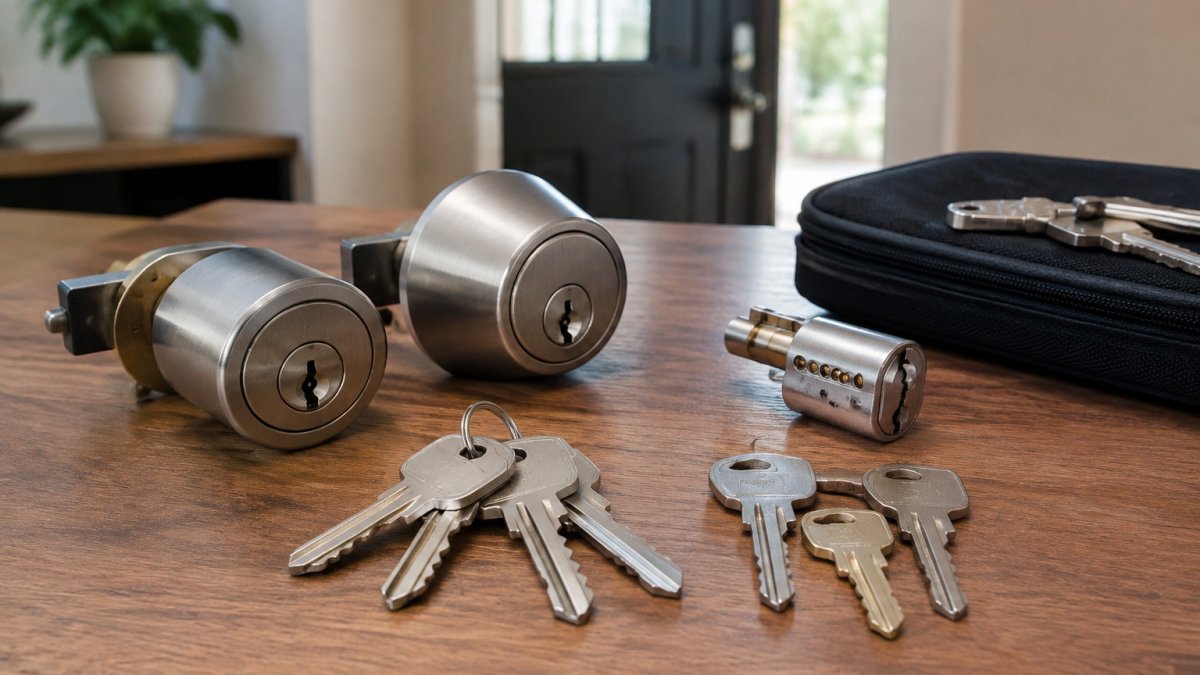
A change key opens only one lock. A submaster opens a group of locks, such as all the bedroom doors on one floor. The master key opens every lock in the system. Together these form a key hierarchy, which is the structure that decides who can reach which doors.
Most residential systems use two or three levels. Adding more levels increases complexity and cost.
Key Benefits for Homeowners and Families
The main reason homeowners choose a master key system is control. A well-designed system reduces the number of keys in circulation while letting you decide exactly who gets in where.

Fewer keys and everyday convenience
Without a master system, a household can end up with a ring of keys for every door. A master system lets one ring carry the keys each person actually needs, which is easier for children, roommates and caregivers. It also makes it simpler to notice when a key goes missing, because you know which keys exist and where they should be.
Access control by person, room and door
Access control is where the system does its most useful work. You can give a teenager access to the front door and their own room, while keeping the home office and garage restricted. If someone moves out or a key is lost, you can rekey the affected locks rather than replacing the entire set.
Residential Master Key System Design: Household Examples
A home has its own logic. The goal is to match the key hierarchy to how people actually move through the house, not to copy an office layout.
Single-family home with two adults and two children
A four-bedroom home with a home office and a detached garage is a typical starting point. The owner holds the master key. Each adult carries a change key for their own bedroom plus a submaster that opens the front door, back door, kitchen, and garage.
This layout uses three levels: master, submaster, and change key. It keeps the children out of the office and garage while letting them enter the house without carrying a full ring. A common mistake is to give the children the same submaster as the adults; that quietly turns the submaster into a second master key.
Multi-generational household with a private suite
When a grandparent or adult child has a private suite with its own entrance, the hierarchy needs a separate branch. The owner keeps the master. The suite occupant gets a change key for the suite door and its interior bathroom, plus a submaster for the shared kitchen and laundry.
A practical detail: put the suite's exterior door on its own change key, not on the family submaster. That way the suite can be rekeyed independently if the occupant changes, without touching the rest of the house.
Rental property with a landlord and on-site manager
The landlord holds the master key and keeps it off-site. The property manager holds a submaster for common areas such as the lobby, laundry room, and maintenance closet. Each tenant receives a change key for their own unit only.
A common pattern is to key each unit's entry door and its interior rooms to the tenant's change key, so the tenant has one key for their whole unit. The landlord's master opens every unit, which is useful for emergencies but creates a single point of compromise.
Accessory dwelling unit (ADU) or home office
An ADU or detached home office works best as a separate branch of the hierarchy. The main house keeps its master and submasters.
This is where keyed-alike locks often fail: if the ADU and main house are keyed alike, a tenant or office visitor can enter the home. A master key system lets you separate the branches while keeping one master for the owner.
A simple rule for planning
Sketch the house as a list of doors, then assign each door to the lowest level that makes sense. Shared entry doors usually sit on a submaster. Private rooms sit on change keys. The master stays with the owner. Keep the hierarchy to two or three levels unless the property genuinely needs more, because each added level increases cost and the chance of a key-control mistake.
Master Key System Advantages and Disadvantages
A master key system is not automatically the right choice. Its advantages are real, but so are its trade-offs.
Advantages:
- Fewer keys to carry and manage
- Clear control over who can access which doors
- Easier rekeying when a key is lost or a person leaves
- Scales well as a household or property grows
Disadvantages:
- A lost master key is a serious security risk, because it opens every lock
- Set-up and rekeying cost more than standard single-key locks
- Poor key control, such as unlisted copies, weakens the whole system
- Overly complex hierarchies become hard to maintain over time
Watch out: keep a written record of who holds each key level. Without it, a single unreturned key can quietly undermine the security of the entire home.
Keyed Alike vs Master Keyed: Which Fits Your Home
Keyed alike and master keyed are often confused. In a keyed-alike system, every lock uses the same key, which is simple and inexpensive but offers no access control. A master keyed system uses the hierarchy described above, giving different people different levels of access.
Keyed alike suits a single-person household or a space where everyone should have identical access. Master keyed suits a family, a shared house or a rental property where access needs to differ by person.
Costs, Installation and When to Rekey Your Home
Cost is the question homeowners ask first, and most guides answer it vaguely. Pricing for a residential master key system depends on the number of locks, the number of key levels, and whether existing locks can be rekeyed or must be replaced. Contact The Key Shop And More for a quote specific to your property.
What drives the price
- Number of locks: each lock must be pinned to the correct level, so more doors mean more labor.
- Key hierarchy depth: two levels are simpler than three or four; each added level increases the chance of error and the number of keys to track.
- Rekey versus replace: rekeying existing locks is generally cheaper than buying new locks, provided the existing hardware is in good condition and uses a compatible keyway.
- Key control features: restricted keyways and patented key blanks cost more but prevent unauthorized duplication.
- Number of keys: each change key, submaster, and master key has a cost, and spares add up.
A common pattern is to rekey the existing locks and add a master key hierarchy in one visit. If the locks are older or mismatched, replacement may be the better long-term choice because mismatched hardware can limit the hierarchy you can build.
What installation involves
A written key register that lists who holds each level and which doors each key opens is a useful part of any master key installation.
When to rekey
Rekeying changes the internal pins so old keys stop working while the existing locks stay in place. Consider rekeying after moving into a home, after losing a key, after a relationship or roommate change, when a former tenant or contractor still holds a copy, or when you add a new household member who should not have the old keys. If a master key is lost, rekeying the affected levels is the priority; a lost master key compromises every lock it opens.
Ongoing ownership costs
A master key system involves ongoing costs. Budget for replacement keys and rekeying when the household changes. Keep the key register current and store the master key securely. If you plan to rent the property later, decide in advance whether tenants will receive change keys only and whether the master stays with you or an on-site manager.
The article breaks down what drives the price of a residential master key system and when rekeying makes sense.
| Cost factor | Effect on price | Note |
|---|---|---|
| Number of locks | More doors, more labor | Each lock must be pinned to the correct level |
| Key hierarchy depth | Deeper levels cost more | Two levels simpler than three or four |
| Rekey versus replace | Rekeying is generally cheaper | Works if existing hardware is in good condition |
| Key control features | Costs more | Restricted keyways and patented blanks prevent copying |
| Number of keys | Each key adds cost | Spares add up over time |
Plan Your Master Key System With The Key Shop And More
Planning a system is easier when you start with a clear list of who needs access to which doors. The Key Shop And More provides key duplication and locksmith services in Rio Linda. If you are ready to set up a system, you can explore our residential rekey service to see what is involved. For spare or replacement access devices for household members, see our vehicle key fobs. To see the full range of services we offer, visit our services page.
Frequently Asked Questions
Does a residential master key system really work?
Yes. A residential master key system works by cutting a set of locks so that one master key operates every lock in the home, while each room or door can still have its own unique key. Each lock has two sets of pin stacks, one matching the change key and one matching the master key, so the cylinder turns for either key. Homeowners use it to reduce the number of keys they carry and to control which family members or service providers can enter specific areas.
Where can you use a master key in a home?
A master key is typically used on the exterior doors, interior doors, and sometimes gates, sheds or garage side doors of a home, depending on how the system is designed. Common setups include a master key for the owner that opens everything, submaster keys for adults or caregivers that open selected areas, and change keys for individual rooms. Storage units, basement doors and home offices can be included or kept on a separate level.
What are the downsides of using a master key?
The main downside is concentrated risk: if the master key is lost or copied, every lock in the home is exposed, so the whole system may need rekeying. Cost is another factor, because a master key system generally costs more than a set of single keyed locks. Keys can also be misplaced or duplicated without authorization if key control is weak. These trade-offs are manageable, but they should be weighed against the convenience and access control the system provides.
Can a master key system be rekeyed if a key is lost?
Yes. If a change key, submaster key or master key is lost, the affected locks can be rekeyed so the lost key no longer works, and new keys are issued. Pricing depends on the number of locks and the complexity of the hierarchy. For the best results, ask your locksmith to rekey after any lost key, after a tenant or staff change, or after a move-in. The Key Shop And More can provide an exact quote for your property.