 how-to
What Does It Cost to Rekey an Entire House?
Last Updated: October 25, 2026
Quick Summary
The cost to rekey house services varies widely depending on how many locks you have, their type, and your location. Most professional locksmiths charge per lock, typically ranging from a base per-cylinder rate plus a service call fee, with total costs depending on whether you have three to five exterior locks rekeyed.
- A typical single-family home has three to five exterior doors with five to eight lock cylinders total.
- Professional locksmiths charge per cylinder, with rates varying by lock type and complexity.
- Service call or trip fees cover travel and consultation, sometimes waived or credited toward the total bill.
- Rekeying costs significantly less than replacing locks because you keep existing hardware and only change internal pins.
- A single lock typically takes 15 to 30 minutes for a professional to rekey.
Table of Contents
- Understanding the Cost of Rekeying an Entire House
- Locksmith Rekeying Cost Per Lock: What You'll Pay
- Service Calls, Trip Fees, and Labor Rates
- Factors That Affect Your Total Rekeying Bill
- Rekey vs. Replace Locks: Which Costs Less?
- How Long Does It Take to Rekey a House?
- Can You Rekey a Lock Yourself to Save Money?
- Getting Your Whole-House Rekey Quote from The Key Shop And More
- Frequently Asked Questions
Understanding the Cost of Rekeying an Entire House
The cost to rekey house services varies widely depending on your home and local market.
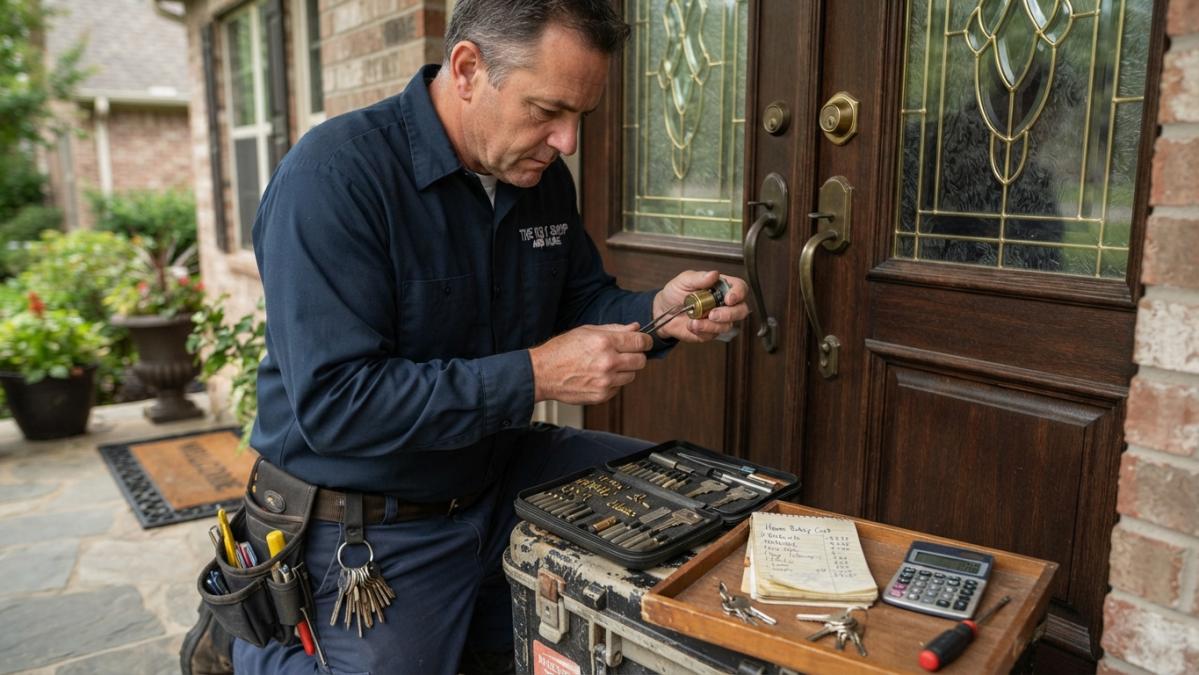
At The Key Shop And More, we know homeowners want clear answers about what rekeying will actually cost.
Your final bill depends on lock count, lock complexity, service fees, and labor rates. Understanding these components helps you budget accurately and avoid surprise charges.
Locksmith Rekeying Cost Per Lock: What You'll Pay
Most professional locksmiths charge per lock, reflecting the time and skill to disassemble the lock, swap the pins, and reassemble it for your new key. You can book a residential rekeying service to get started.
Standard deadbolts and door locks fall into one pricing tier.
The per-lock rate is straightforward: multiply it by your lock count for a rough estimate before calling for a formal quote.
Lock complexity matters: standard pin-and-tumbler locks take less time than high-security models, and older or unserviced locks may need extra care.
Service Calls, Trip Fees, and Labor Rates
Beyond the per-lock cost, most locksmiths charge a service call or trip fee covering travel, fuel, and the initial consultation.
Labor rates vary by location and locksmith: some bill hourly, others bundle labor into per-lock pricing.
Emergency calls cost significantly more than standard business-hours appointments. After-hours, weekend, and holiday rekeying carries a premium reflecting the locksmith's availability outside normal hours.
Factors That Affect Your Total Rekeying Bill
Most articles list the same broad factors, lock count, lock type, timing, without showing how they combine into a whole-house total. Treat your home like a small project estimate: count the cylinders, add the service call, apply labor, and check for add-ons.
Start by counting cylinders, not doors
A "whole-house rekey" is priced by the number of lock cylinders needing new pins, not by doors. One exterior door often has two cylinders, a deadbolt and a knob or lever. Before requesting a quote, walk your exterior and count every keyed cylinder, including:
- Front door deadbolt
- Front door knob or lever
- Back door deadbolt and knob/lever
- Side door lock
- Garage entry door lock
- Any keyed patio or storm door lock
A typical single-family home has three to five exterior doors, often meaning five to eight cylinders, that count, not the door count, drives the per-lock portion of your bill.
A simple itemized estimator
Use this structure to build a rough whole-house estimate, replacing the placeholder figures with quotes from two or three local locksmiths.
| Line item | What to count | How it is usually priced |
|---|---|---|
| Per-cylinder rekey | Each keyed cylinder | Flat rate per cylinder, often tiered by lock type |
| Service call / trip fee | One per visit | Flat fee, sometimes waived or credited |
| Labor | Time on site | Bundled into per-cylinder rate or billed hourly |
| Hardware | New keys, pins, cylinders if needed | Per key or per cylinder |
| Add-ons | High-security locks, damaged hardware, after-hours | Quoted separately |
Example: six standard cylinders at a $25-per-cylinder rate plus a $75 service call estimates as 6 × $25 + $75 = $225 before tax and add-ons. If labor is bundled into a $40-per-cylinder rate with the service call waived, the same job estimates as 6 × $40 = $240. The structures can land close together, so ask what is included, not just the headline rate.
The variables that move the number most
- Cylinder count: The single biggest driver. Going from four to eight cylinders can roughly double the per-lock portion of the bill.
- Lock type and complexity: Standard pin-and-tumbler cylinders are the baseline. High-security cylinders, restricted keyways, and specialty mechanisms take more time and may require specific pins or tools.
- Lock condition: Corroded, painted-over, or damaged cylinders may need extra labor or may not be rekeyable at all, turning a rekey into a replacement.
- Service timing: After-hours, weekend, and holiday calls typically carry a premium over standard business hours.
- Travel and location: Rural calls may include longer travel; dense urban markets may have higher base rates but more competition.
- Single-key setup: If you want every cylinder to work with one key, confirm the locks share a compatible keyway. If they do not, the locksmith may need to replace cylinders or hardware, which changes the estimate.
Questions that prevent surprise fees
Before you book, ask:
- Is the service-call fee included in the per-cylinder rate or added on top?
- Is there a minimum charge for small jobs?
- Are new keys included, and how many?
- Does the price change for high-security or restricted-keyway cylinders?
- Is there an after-hours or weekend surcharge?
- Are taxes and disposal or hardware fees extra?
A locksmith who answers these clearly gives you a comparable quote; one who quotes only a per-lock number gives you a number you cannot compare.
Rekey vs. Replace Locks: Which Costs Less?
Cost often decides between rekeying and replacing locks. Rekeying is typically more affordable because you keep your existing hardware and only change the internal pins.
Lock replacement means removing your old locks and installing new ones, requiring new hardware, installation labor, and possibly new strike plates or door frame modifications.
The cost difference can be substantial: rekeying costs less in labor and materials, making it the budget-friendly choice for most homeowners.
How Long Does It Take to Rekey a House?
The time to rekey your entire house depends on lock count and complexity.
A typical three-lock home takes 45 minutes to an hour and a half; a five-lock house, two to three hours, assuming standard locks in good condition.
Complications add time: stuck, corroded, or hard-to-disassemble locks, unexpected lock types, or damage found during disassembly all extend the job.
Most locksmiths schedule rekeying in the morning or early afternoon to finish during normal business hours.
Can You Rekey a Lock Yourself to Save Money?
DIY rekeying is not a single yes-or-no question. It depends on the lock brand, whether the cylinder is rekeyable, whether a compatible kit exists, and your tolerance for risk. A practical decision guide is more useful than a blanket warning.
Step 1: Identify whether your locks are DIY-rekeyable
Many standard residential cylinders can be rekeyed with a homeowner kit, but not all. The key question is whether the cylinder can be removed and whether replacement pins or a rekey kit are available for that specific model.
A practical test: remove the interior thumb-turn or rose, confirm the cylinder can be extracted, and check whether the manufacturer or a reputable kit maker lists your model. If you cannot confirm a compatible kit, treat it as a locksmith job.
Step 2: Match the kit to the lock
Rekey kits are not universal. They typically include a follower, pin tools, and a set of pins in common lengths. You need the kit that matches your cylinder type and keyway. Using the wrong pins or forcing a follower can damage the cylinder or leave the lock in a non-secure state. If the kit does not explicitly list your lock model or keyway, do not assume it will work.
Step 3: Decide based on scope and risk
Use this decision guide:
- One or two standard cylinders, confirmed compatible kit, prior mechanical experience: DIY is reasonable if you are comfortable and can test thoroughly.
- Three or more cylinders, mixed brands, or any high-security lock: The time, tool cost, and risk of damage usually outweigh the savings. Professional rekeying is the better choice.
- Any lock that is corroded, painted, damaged, or difficult to disassemble: Do not force it. A damaged cylinder can turn a rekey into a replacement.
- Any lock you depend on for primary security: If you cannot verify the lock works correctly after reassembly, call a professional.
Tools and skills you actually need
A typical DIY rekey involves a screwdriver set, a plug follower, a pin tool or tweezers, replacement pins, and a new key. The skill is not complicated, but it is unforgiving: a single misplaced pin can make the lock inoperable or leave it able to be opened by the old key. Testing every key and every lock after reassembly is not optional.
The real trade-off
DIY saves the labor and service-call portion of the bill, but it costs time, tool purchases, and risk. For a whole house, the math usually favors a professional because the per-cylinder savings shrink as the cylinder count rises and the cost of one damaged lock can exceed the entire DIY savings.
Getting Your Whole-House Rekey Quote from The Key Shop And More
When you're ready to move forward with rekeying your entire house, getting an accurate quote is essential. Contact The Key Shop And More to request a quote for your specific situation.
Provide details about your home's layout and any special requirements. If you want all locks keyed to one master key, mention that.
A reputable locksmith will give you a detailed breakdown of costs, including per-lock pricing, service fees, and any additional charges. They'll explain what's included and what isn't.
Compare quotes from multiple locksmiths, but don't choose based solely on price.
Once you've selected a locksmith, schedule your appointment at a time that works for your schedule.
Frequently Asked Questions
What is the typical price range for rekeying an entire house?
The cost of rekeying an entire house depends on the number of locks, their type, and complexity, plus any service fees. For a typical home with 4-5 locks, pricing varies based on whether you choose standard or high-security cylinders and whether the locksmith charges a trip fee or hourly labor rate. Contact The Key Shop And More for a transparent quote tailored to your property.
Is it cheaper to rekey or replace locks?
Rekeying is almost always less expensive than lock replacement. Rekeying changes only the cylinder's internal pins so a new key works, keeping your existing hardware. Lock replacement means buying entirely new locks and hardware. If your locks are in good condition and you simply need new key control after a move or security concern, rekeying is the cost-effective choice.
Can I rekey a lock myself?
You can attempt DIY rekeying with a rekey kit if you have mechanical skill and the right tools, but it requires precision and understanding of lock mechanics. Most homeowners find professional rekeying faster and more reliable, especially for a whole-house job. Mistakes can damage the lock or leave it insecure. The Key Shop And More handles the work correctly and efficiently.
How long does it take to rekey a house?
Rekeying a typical 4-5 lock home usually takes 1-3 hours, depending on lock complexity, accessibility, and how many cylinders need rekeying. High-security locks take longer than standard deadbolts. A professional locksmith can work through multiple doors efficiently and ensure all locks are keyed alike if you want a single-key setup for convenience.
Rekeying your entire house is a practical security step that doesn't require replacing all your locks. The cost depends on your specific locks, your location, and whether you hire a professional. At The Key Shop And More, we help homeowners understand their rekeying options and provide transparent pricing for the work. Get in touch with our team to discuss your rekeying needs and receive a quote tailored to your home's security requirements.