 listicle
Locksmith Services for Property Managers
Last Updated: October 23, 2026
Quick Summary
Locksmith services for property managers address managing access across multiple units, handling tenant transitions safely, and maintaining compliance through coordinated rekeying schedules, documented key trails, emergency response protocols, and volume-based pricing that works across dozens of units annually.
- Rekey locks between tenants before new occupants receive keys, taking 15-30 minutes per unit and costing less than lock replacement.
- Master key systems require strict key control including restricted keyways, key tracking logs, checkout procedures, and lost-key protocols to remain secure.
- Batch turnover rekeying appointments on the same day to reduce per-unit costs and ensure consistent turnaround times.
- Establish written service agreements specifying response times, pricing tiers, documentation standards, and warranty terms before hiring a locksmith partner.
- Label spare keys with numeric codes tied to a secure off-site master log, never with property addresses or unit numbers.
Table of Contents
- Why Property Managers Need Dedicated Locksmith Services
- Rekeying Locks Between Tenants: The Standard Turnover Process
- Master Key Systems for Property Managers: Control and Compliance
- Key Duplication for Property Managers: Scaling Access Across Units
- How to Label Spare Keys Securely Without Revealing Property Addresses
- Emergency Lockouts and 24/7 Access Solutions
- Choosing the Right Locksmith Partner: Vendor Evaluation and Service Agreements
- Transparent Pricing, Response Times, and Compliance Standards
- Frequently Asked Questions
Why Property Managers Need Dedicated Locksmith Services
Locksmith services for property managers address a specific operational need: managing access across multiple units, handling tenant transitions safely, and maintaining compliance without becoming a bottleneck.
The challenge isn't finding a locksmith, it's finding one who understands the scale of managing residential or commercial properties. Generic locksmiths treat each job as a one-off; property management requires systems: coordinated rekeying schedules, documented key trails, emergency response protocols, and pricing that works across dozens of units annually.
At The Key Shop And More, we understand what property managers actually need.
Rekeying Locks Between Tenants: The Standard Turnover Process
Rekeying between tenants is the most routine but critical service property managers use. Book a Property Management ReKey to schedule turnover rekeying for your units.
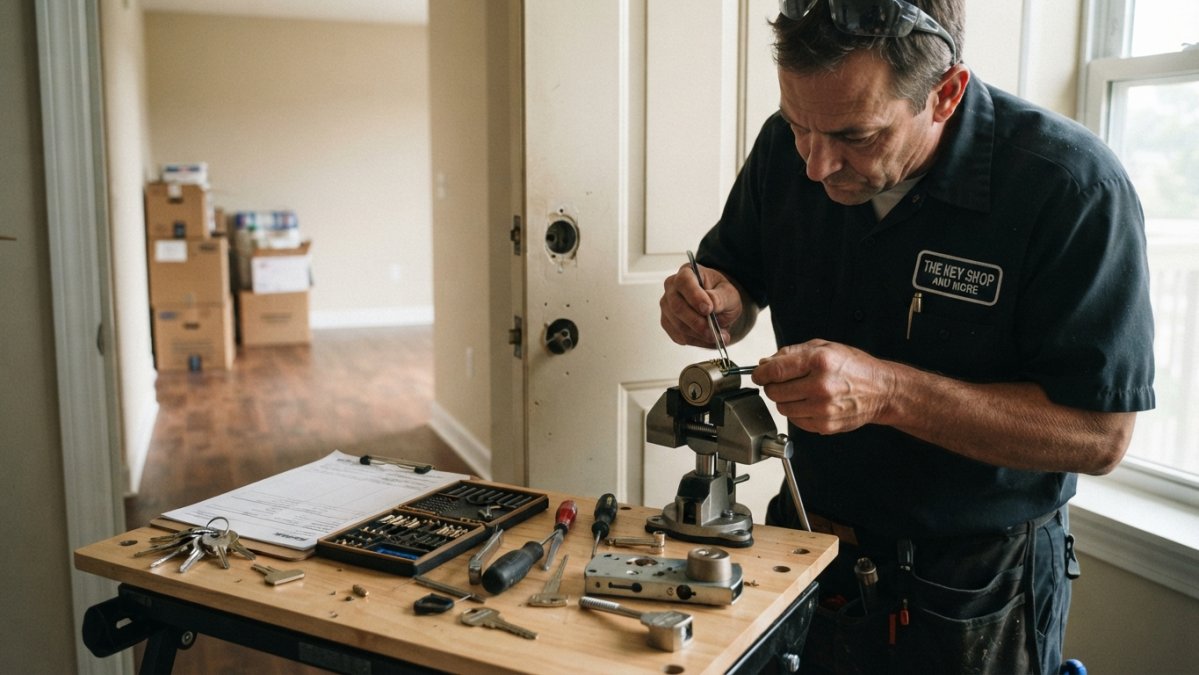
A locksmith removes the lock cylinder, replaces the pins to match a new key configuration, and reinstalls it; the lock mechanism stays in place. For urgent turnover situations, book an Eviction ReKey for expedited service.
Turnover rekeying should happen before new tenants receive keys, many property managers schedule it during the final walkthrough or cleaning phase.
Common mistakes include delaying rekeying until after a tenant moves in (creating a security gap) or assuming a single key change suffices for multi-unit buildings. Every unit should have its own unique key configuration unless you intentionally use a master key system.
Master Key Systems for Property Managers: Control and Compliance
Master key systems let property managers access any unit with a single key while tenants use individual keys for their own units, enabling emergency access, maintenance, and inspections without violating tenant privacy.
A master key system works through a hierarchical pin configuration: the master key operates every lock, while individual tenant keys open only their specific unit.
Property managers in multifamily buildings almost always need master key systems, and they're equally valuable for condo associations managing common areas plus individual units.
Key control is the real system
A master key system is only as secure as its key-control program. The hardware is the easy part; governance is where most properties get into trouble. A practical program covers:
- Restricted keyways. Specify a patented or restricted keyway so keys cannot be copied at a hardware store without authorization. This is the single most effective control against unauthorized duplication.
- Key tracking. Maintain a log of every key issued, to whom, for which unit or area, and the date. Include master keys, sub-masters, maintenance keys, and spare keys.
- Checkout and return procedures. Require signed checkout for master keys used by maintenance staff or contractors, with a return deadline and a documented chain of custody.
Compliance, fire safety, and accessibility
Many jurisdictions require property managers to maintain access for emergency services and inspections. A well-designed master key system satisfies these requirements while protecting tenant privacy during normal operations.
Lock and access-control choices also interact with fire and life-safety codes. Doors on egress paths must remain openable from the inside without a key, and electrified hardware often must fail safe or fail secure in ways the local authority having jurisdiction approves.
Key Duplication for Property Managers: Scaling Access Across Units
Key duplication is the workhorse service for property managers managing dozens or hundreds of units, covering spare keys for maintenance staff, emergency access, and tenant replacements.
Duplication quality matters more than most property managers realize. A poorly cut key can jam in locks, requiring a locksmith call and potentially trapping tenants or staff.
Property managers typically maintain a spare key inventory for each unit, serving three purposes: quick replacements when tenants lose keys, maintenance access without scheduling coordination, and emergency access when original keys are unavailable.
Bulk duplication discounts apply across multiple units. Pricing typically drops when ordering 10+ keys at once, making it economical to maintain a healthy spare inventory rather than duplicating on demand.
How to Label Spare Keys Securely Without Revealing Property Addresses
Labeling spare keys creates a security dilemma: you need to know which key opens which lock, but you can't label a key with the property address or unit number.
The solution is a coded labeling system: use a numeric or alphanumeric code tied to a master log stored securely off-site.
Property managers often add color-coded key rings: red for one property, blue for another. Purchase Green Key color-coded keys to implement this secure labeling system.
Never label keys with tenant names, unit numbers, or property addresses. Even innocuous labels like "Main" or "Backup" can be problematic if a lost key is found by someone with access to your property layout.
Emergency Lockouts and 24/7 Access Solutions
Lockouts happen at the worst times: tenants locked out at midnight, maintenance staff unable to access a unit during an emergency, or a tenant losing their only key on a weekend.
A dedicated locksmith partner should offer emergency response without surprise pricing. Establish an agreement upfront covering emergency calls, response-time expectations, and billing.
Emergency lockout response typically takes 30 minutes to 2 hours depending on availability and distance. For multifamily properties, having a locksmith within 15-20 minutes of your location is a practical requirement.
Some property managers maintain a spare master key with a trusted staff member or in a secure off-site location specifically for emergency access. This backup enables faster response than waiting for a locksmith, though it requires careful key control and documentation.
Choosing the Right Locksmith Partner: Vendor Evaluation and Service Agreements
Selecting a locksmith partner is more important than most property managers realize. You're not just hiring someone to cut keys; you're delegating security decisions and emergency access to this vendor. The right partner reduces turnover costs, keeps documentation audit-ready, and responds predictably when something fails at 2 a.m.
A practical vendor evaluation checklist
Use the same criteria for every candidate so proposals are comparable. View all available Services and contact information to evaluate and hire the right locksmith partner. A property-management-grade locksmith should answer all of the following in writing:
- Licensing and registration. Confirm the business is licensed or registered as required in your jurisdiction, and that individual technicians are identifiable and vetted.
- Insurance. Request a certificate of general liability insurance and, where applicable, workers' compensation coverage. Verify limits are adequate for work inside occupied units.
- Background checks. Ask whether technicians who will enter occupied units are background-checked, and how the vendor handles subcontractors.
What belongs in a service-level agreement
A written service agreement prevents misunderstandings and protects both parties. At minimum, specify:
- Response-time commitments for emergency and routine calls, including after-hours definitions.
- Pricing for common services and how after-hours, holiday, and emergency premiums are calculated.
- Documentation requirements: service reports, photos, and key-change records delivered within a set time.
Compliance and accessibility questions to ask
Before signing, ask how the vendor handles fire and life-safety requirements on egress doors, accessibility considerations for hardware, and local code requirements for multifamily properties. A locksmith who regularly serves property managers should flag when a requested change may conflict with egress or accessibility rules and recommend verifying with the local authority having jurisdiction.
Ask prospective locksmiths about their documentation process. Do they photograph locks before and after service? Do they provide written reports of what was changed and when? Do they maintain records you can access for compliance audits? These details matter for documentation and liability protection.
Transparent Pricing, Response Times, and Compliance Standards
Transparency in locksmith pricing prevents budget surprises and builds trust with your property management team.
Many property managers negotiate tiered pricing based on volume.
Response time commitments matter equally.
| Service | Typical Scope | Response Expectation | Documentation |
|---|---|---|---|
| Standard Rekeying | One unit lock cylinder rekey | 24-48 hours scheduling | Before/after photos, written report |
| Emergency Lockout | After-hours access restoration | 30-90 minutes from call | Call log, service report, charges |
| Master Key Setup | Multiple units keyed to hierarchy | 1-2 weeks coordination | System diagram, key documentation |
| Key Duplication | Bulk spare key production | 3-5 days | Quantity log, quality verification |
Compliance requirements vary by jurisdiction. Some areas require documented proof that locks were changed between tenants.
Effective locksmith services for property managers aren't a commodity purchase, they're a core operational partnership.
Frequently Asked Questions
What locksmith services do property managers need most?
Property managers typically need rekeying between tenant turnovers, master key system setup and maintenance, emergency lockout response, key duplication for staff and maintenance teams, and lock repairs or replacements. Access control integration and documentation services also matter for compliance and security tracking. The specific mix depends on property size, unit count, and whether the portfolio includes residential, commercial, or mixed-use buildings.
Should rental property locks be rekeyed between tenants?
Yes. Rekeying between tenants is a critical security practice because you cannot verify how many copies of the previous tenant's keys exist. A professional locksmith rekeying ensures only current tenants and authorized staff have access. This protects tenant privacy, reduces unauthorized entry risk, and demonstrates due diligence to insurance carriers and regulatory bodies overseeing multifamily or condo properties.
How can property managers control access to multiple units?
Master key systems allow one key to open multiple units while individual unit keys open only that unit. This gives property managers, maintenance staff, and emergency responders efficient access without duplicating keys for every person. Electronic locks and access control systems offer additional layers: temporary codes for contractors, audit trails of who entered when, and remote access management. Combining physical master keys with electronic systems provides flexibility and security.
How should property managers label spare keys without revealing the address?
Use a coded numbering or color system tied to an internal database rather than unit numbers or addresses. For example, assign each unit a code (Unit-A-01) and store the master list separately in a secure location. Some property managers use color-coded tags or laminated cards with only the code visible. This prevents anyone finding a spare key from identifying which property or unit it opens, reducing theft and unauthorized entry risk while keeping your key management system organized.
How can property managers choose a reliable locksmith?
Verify licensing, insurance, and references from other property managers or management companies. Request a free assessment of your property's security needs and key control setup. Compare response times for emergency calls and confirm availability outside business hours. Ask about pricing transparency (flat rates vs. hourly), whether they offer volume discounts for bulk rekeying, and if they provide documentation and key tracking services. A reliable locksmith should also be willing to discuss compliance requirements and security best practices specific to your property type.