 listicle
7 Signs of a Fake Locksmith You Should Never Ignore
Last Updated: October 27, 2026
Quick Summary
A fake locksmith is a person or business that advertises locksmith services without the skills, licensing, or local presence to deliver them honestly. Scammers often route calls to unvetted subcontractors who arrive in unmarked vehicles and charge inflated invoices. Asking for a company name, street address, and total price before dispatch helps you avoid them.
- Ask for the full legal business name and a physical street address before dispatch.
- Get a total price ceiling, including the service-call fee, labour, and parts.
- Refuse cash-only demands and ask for an itemised invoice before paying.
- Ask whether a non-destructive entry was tried before agreeing to drilling or replacement.
Table of Contents
- Warning Signs of a Fake Locksmith on the Phone
- Red Flags When the Technician Arrives
- How to Avoid Locksmith Scams Before You Call
- How to Find a Reputable Locksmith
- Locksmith Pricing and Estimates: What Is Normal
- What to Do After a Locksmith Scam
- Booking a Verified Locksmith in Rio Linda
- Frequently Asked Questions
Locked out of your home or car, you need someone fast, and that urgency is exactly what fake locksmiths count on. Understanding why these scams work is the first step to avoiding one.
A fake locksmith is a person or business that advertises locksmith services without the skills, licensing, or local presence to deliver them honestly. Many operate as lead-generation middlemen that route calls to unvetted subcontractors who arrive with unmarked vehicles and inflated invoices.
Scammers thrive because the moment of need leaves little room for comparison shopping. When you are standing outside a locked door at night, you rarely have time to check credentials. Search ads also make it hard to tell a local business from a national call center posing as one. That gap between what looks legitimate and what actually is legitimate is where most scams live.
Consumer protection agencies in several countries have repeatedly warned about locksmith fraud, and the pattern is consistent. Check current guidance from UK Trading Standards consumer advice on locksmiths before you call anyone.
Warning Signs of a Fake Locksmith on the Phone
The first real opportunity to spot a scam is the phone call itself. A legitimate locksmith will ask where you are, what kind of lock you have, and whether you need entry, a repair, or a replacement. A scammer often skips those questions and jumps straight to a low price.
Watch for these phone-stage warning signs:
- A quote that sounds unusually cheap, with the total left vague
- No company name given when you call, or a generic greeting only
- Pressure to decide immediately
- A refusal to give a business address or a phone number you can call back
- Cash-only payment demanded before work starts
- The person cannot tell you the name of the technician who will be dispatched
- The call is answered by a national call centre that routes you to a "local partner"
A vague quote is the most common trap. The advertised price covers only a "service call" or a "lockout fee," and the real cost is revealed after arrival. Ask directly what the total will be, including any fees for entry, parts, and after-hours work.
The call-before-dispatch checklist
Most guides tell you to "ask questions" but never tell you which ones. Use this exact script before anyone is sent to your door. Write the answers down, including the time of the call and the name of the person you spoke to.
- What is the full legal business name, and how is it spelled? A legitimate business answers with its own name, not a generic "locksmith service."
- What is your physical street address? A real local business has one. A PO box or a national call centre number is a warning sign.
- What is the name of the technician you are sending, and will they arrive in a marked vehicle? If the dispatcher cannot name the technician, you are likely being routed to an unvetted subcontractor.
- What is the total price, including the service-call fee, labour, parts, and any after-hours charge? Ask for a ceiling, not a "starting from" figure.
- Is there a separate service-call or attendance fee even if no work is done? Legitimate businesses often charge one; scammers hide it until arrival.
- What payment methods do you accept, and will I get an itemised invoice before paying? Cash-only demands before work starts are a major red flag.
- Can you give me your licence or registration number so I can verify it? Rules vary by location, but a legitimate operator can point you to the relevant authority.
If the person on the phone cannot or will not answer these questions, hang up and call someone else. A legitimate locksmith will not be offended by them; a scammer will pressure you to stop asking.
Our advice is simple: if the person on the phone cannot give you a clear total and a company name, hang up and call someone else.
Red Flags When the Technician Arrives
Even if the phone call seemed fine, the technician's arrival is the next checkpoint. Real locksmith businesses send identifiable technicians who work from marked vehicles. A fake operator often shows up in an unmarked van with no uniform, no company logo, and no ID.
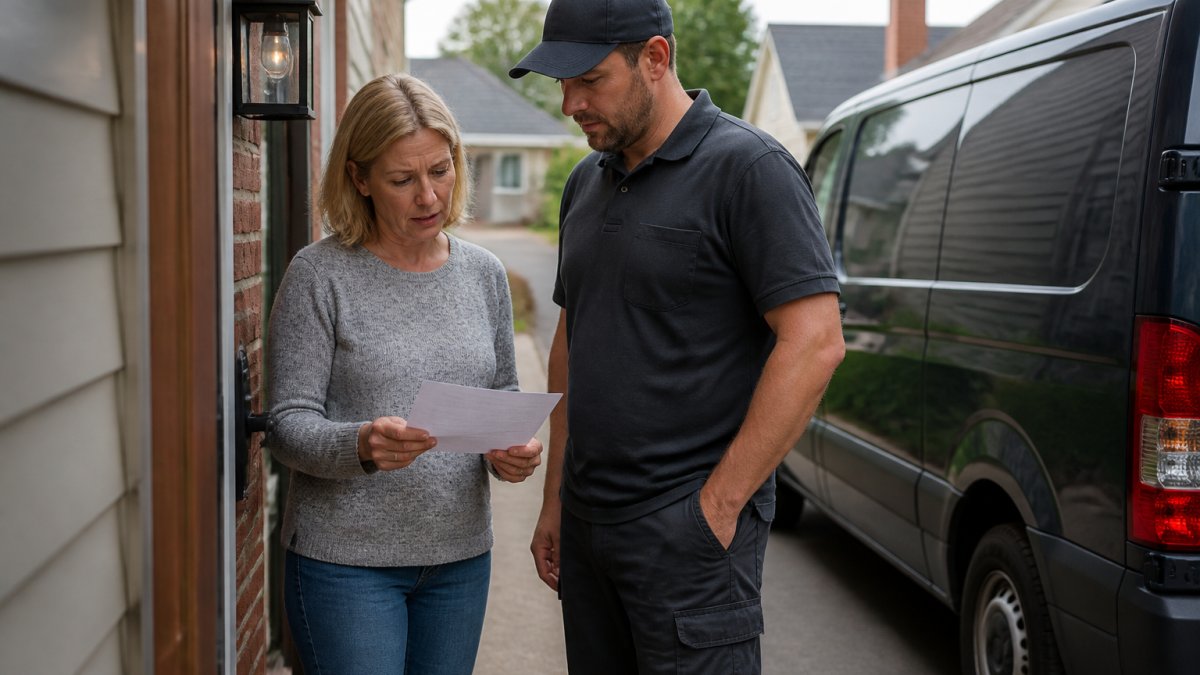
Common on-site red flags include:
- No company name on the vehicle or the technician's clothing
- Refusal to show identification or a business licence
- A price that jumps significantly after the door is opened
- Immediate suggestions that the lock must be drilled or replaced
- Pressure to approve expensive work before you have time to think
The drilling pitch deserves special attention. Drilling a lock is sometimes necessary, but a scammer may recommend it to create extra charges even when a non-destructive entry would have worked. Ask the technician whether they have tried a non-destructive method first, and ask for a written estimate before any work begins.
Do not let the technician rush you. You are entitled to read an invoice and ask questions before you sign or pay.
How to Avoid Locksmith Scams Before You Call
Preparation before an emergency makes the scam far less likely. Save a reputable local locksmith's number in your phone now, so you are not forced to choose from search results at a stressful moment.
A practical pre-call checklist:
- Find at least two local locksmiths and save their numbers
- Check the business name against a physical address on a map
- Confirm the company answers the phone with its own name
- Ask for a total price, including all fees, before dispatch
- Ask what payment methods are accepted
- Ask for the technician's name and the company's licence number
If a company will not answer these basic questions over the phone, that tells you what you need to know. For background on consumer rights when hiring trades, see Citizens Advice guidance on hiring tradespeople.
How to Find a Reputable Locksmith
A reputable locksmith is easiest to identify through verifiable credentials rather than advertising. Start by checking whether the business is listed with a recognised trade body, and whether its address and phone number match a real local presence.
Here is a useful way to compare options:
| Check | What a Legitimate Business Shows | What a Red Flag Looks Like |
|---|---|---|
| Business name | Consistent across phone, van, and website | Different names on each touchpoint |
| Location | A verifiable local street address | Only a PO box or a national call centre |
| Credentials | Licence or association membership you can verify | Vague claims with no verification |
| Pricing | Clear total given before dispatch | "Starting from" with no ceiling |
You can ask about our services directly. You can review what we offer on our [page:1] or read about our [page:3] before you call.
The Master Locksmiths Association also maintains a vetted directory that lets consumers search for qualified members, which is a useful starting point. You can find it at Master Locksmiths Association find a locksmith directory.
Locksmith Pricing and Estimates: What Is Normal
Pricing for locksmith work varies widely, and it depends on the time of day, the type of lock, the method of entry, and the distance the technician travels. Because prices are so variable, we do not publish a single "typical" figure here. Instead, focus on whether the estimate is transparent and whether each component is explained before work begins.
A fair estimate should clearly separate the following components. Ask the dispatcher to walk through each one on the phone, and ask the technician to confirm them in writing before starting.
- Service-call or attendance fee. A fixed charge for showing up, separate from the work itself. Legitimate businesses often charge this even if no entry is performed. A scammer may advertise "no call-out fee" and then inflate the labour instead.
- Labour for entry or repair. The time-based or fixed charge for opening the door or fixing the lock. Ask whether the labour rate changes for after-hours, weekends, or holidays.
- Parts. Replacement cylinders, keys, handles, or lock bodies. Ask whether the part is included in the quoted total or billed separately.
- After-hours or emergency premium. A common and legitimate surcharge for nights, weekends, and public holidays. The key is that it is disclosed before dispatch, not added on arrival.
- Replacement versus repair. A rekey or re-pin of an existing lock is usually cheaper than a full replacement. Ask which one the technician recommends and why.
A common scam pattern is to quote only the service-call fee on the phone, then present a much larger labour and parts bill once the door is open. Another is to quote a low "starting from" price that applies only to the simplest lock and never to yours. Neither is transparent, and both are avoidable if you insist on a total ceiling before dispatch.
If you are quoted a price for a rekey or duplicate key, confirm whether the lock needs replacing or whether the existing mechanism can be re-pinned. If the technician recommends drilling or replacement, ask what non-destructive methods were attempted first and what the additional cost will be. A justified destructive entry should be explained before it happens, not after.
Please contact us or visit our website for a quote tailored to your needs.
What to Do After a Locksmith Scam
If you believe you have been overcharged or defrauded, act quickly and keep records. Save the phone number that called you, any text messages or emails, photographs of the invoice, and the name or licence number the technician gave you.
Steps to take:
- Do not pay any additional amount beyond what you agreed in writing
- Request an itemised invoice and keep a copy
- Report the company to your local consumer protection body
- If you paid by card, contact your bank to ask about a chargeback
- Leave an honest review so other customers can avoid the same business
Reporting helps authorities track patterns of fraud, which is how many scam operations are eventually shut down. Your complaint matters even if you recovered your money.
Booking a Verified Locksmith in Rio Linda
If you are locked out or need a lock replaced, choosing a verified local provider protects you from the scams described above. The Key Shop And More serves Rio Linda.
You can request a residential rekey to secure your home after a change of occupants.
Call us to talk through your options.
Frequently Asked Questions
How can you tell if a locksmith is legitimate?
Ask for the business name and check it independently. Where licensing applies in your area, consult the relevant issuing body for current guidance.
What should you do if a locksmith gives you a much higher price after arriving?
Ask the technician to explain the extra charges in writing, and point out that the price you were quoted on the phone was different. Keep a record of the conversation, the company name and the vehicle details.
Is it normal for a locksmith to insist on drilling a lock?
Ask the technician to explain why drilling is being recommended and what alternatives are available.
What should you do if you think a locksmith has scammed you?
Keep receipts, text messages and call records, and take photos of the vehicle and any marketing material.